| Photojournal
- 2 March 2008
A free day
On the second of March I woke up in 100-Mile House with a free day in front of me. I wasn't due to arrive at the resort I was headed to until sometime in the afternoon or evening, and it was just ten minutes' drive up the road.
So after breakfast, I collected my camera from my room and went out driving to see what I could find. Driving in the interior of British Columbia in the beginning of March can be a hazardous thing, so I had my tire chains in my car, as well as a blanket, bottled water, a first-aid kit, a bit of food, and my hat. It really pays to be prepared; if you happen to drive off of the road, you might be there for a pretty long time. |
|
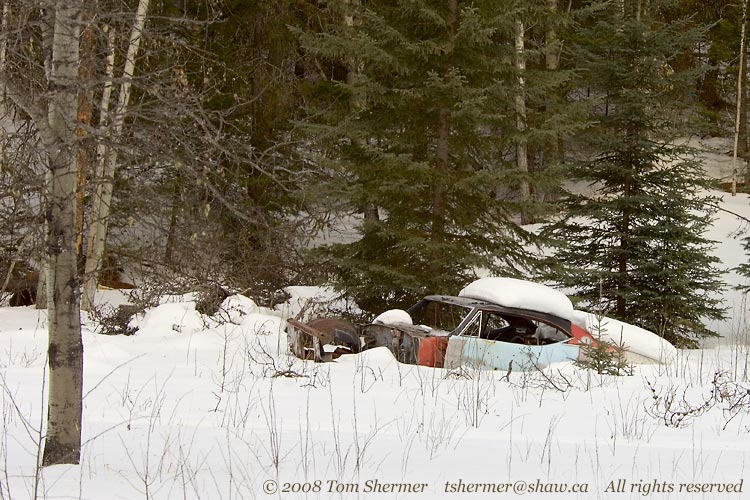 |
Hopefully not as long as that guy, but you never know.
I had gotten off of the main highway on a road called Spring Lake Road, which I had travelled once before a few summers ago. At that time, I had seen lots of different birds, including about a dozen American Kestrels—small, colourful falcons—flying around and perching on the utility wires. This time, I saw no kestrels, and in fact, it took me about a half an hour before I found birds of any sort.
I stopped my car when I saw a flash of red fly across the road in front of me. My impression of the flying bird was that it was a finch in the genus Carpodacus, which is the most common sort of smallish birds having red on them (and lacking other distinguishing features). After I got my binoculars on the bird, though, I found him a little more red than I expected, and having a definitely non-Carpodacus sort of bill.
In fact, the bill on the bird was quite distinctive, with the lower mandible curving up at the end and the upper mandible curving down. The two curvy parts were offset a little so they didn't collide. From the bill, I surmised immediately that I had found a species that I looked for but never found before: the Red Crossbill. |
|
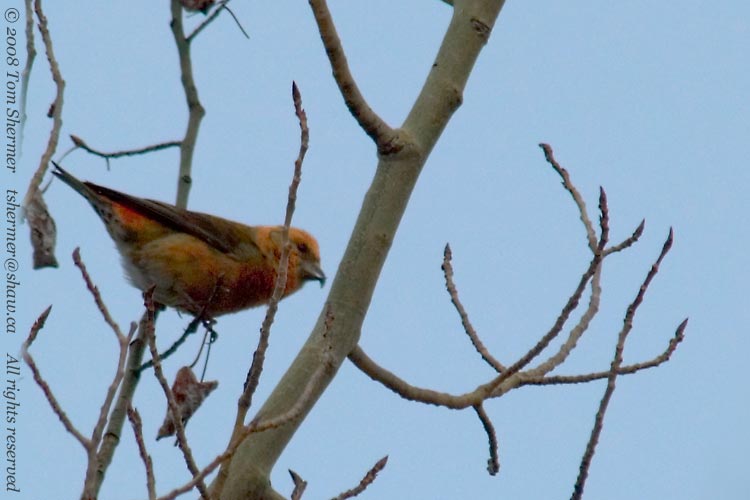 |
Red Crossbills are a sort of finch, so my first guess at least wasn't all that far off.
Female Red Crossbills are yellow. Maybe the species should be called Yellow Crossbill. |
|
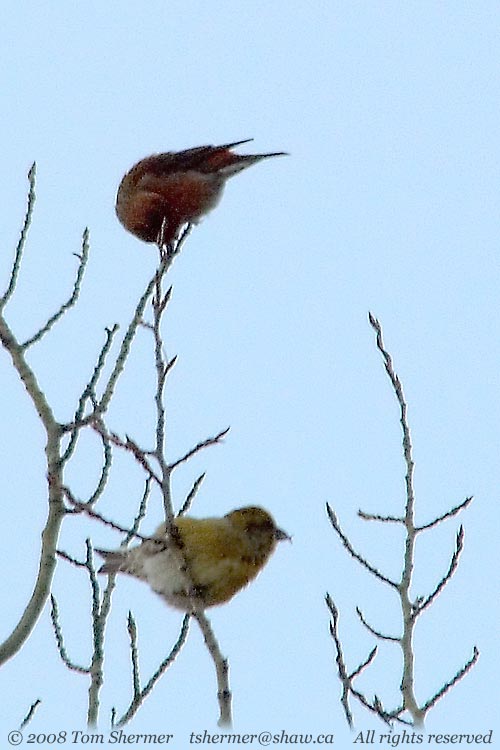 |
Please excuse the noise in that photo, and in the ones that follow. The conditions were difficult, as the sky was very bright and the birds were dark, and I had to increase the brightness on the birds, which also increased the brightness on the noise.
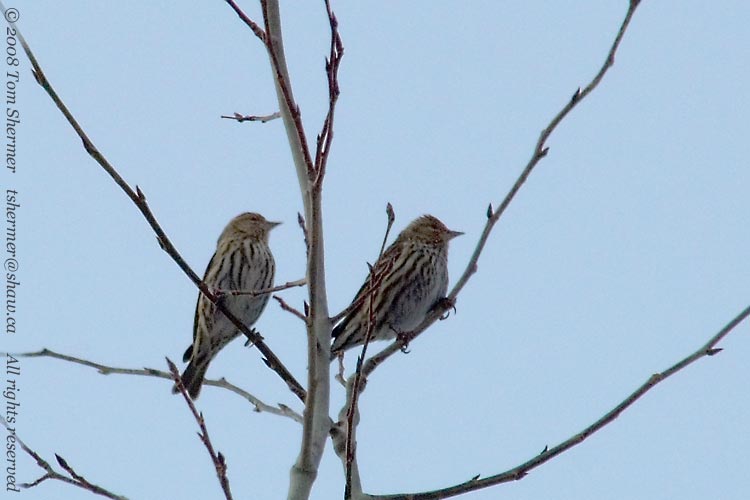
Hanging out with the crossbills were a few Pine Siskins, another type of finch. It's not uncommon to see mixed flocks of finches. |
|
 |
| After my finch photos, I drove on down the road, again finding little bird life around. I took a few snowy landscapes. The first was of an interesting half-open barn with license plates nailed to the front. |
|
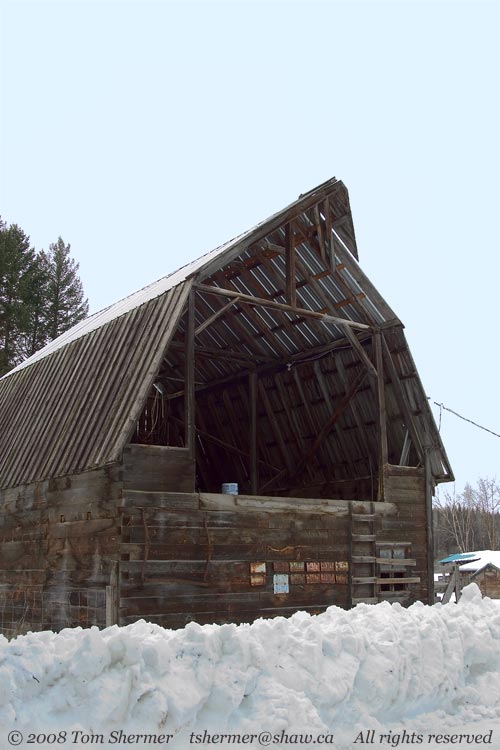 |
One thing I really love about this area of the country is the feel of the forests: they're quite open and have a mix of deciduous and coniferous trees. The deciduous is mainly birch, which are quite photogenic. So I took a bunch of shots to try to capture this feel. |
|
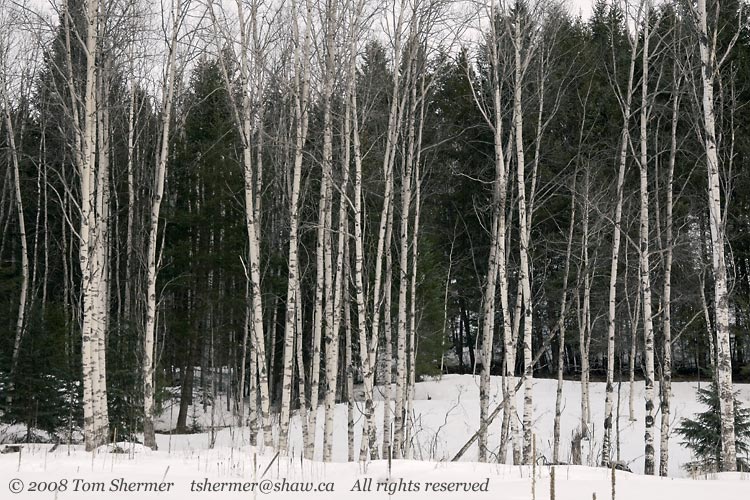 |
I was a little disappointed in the way they turned out, and I had to apply a lot of Photoshop to bring out even a hint of what I had been seeing.
After some more driving around, I found myself back at the place where I'd seen the finches earlier. This time I saw some smaller birds flitting around, going back and forth across the road. The lighting conditions were much better than before, with the clouds having moved on, and with the birds sometimes perching where they were frontlit rather than backlit.
So I had to stop, and I spent 40 minutes or so taking photos. I had recognized the flock as mainly chickadees, and figured that I would find some Mountain Chickadees amongst them. There were indeed a couple of these beauties, and one provided me with my closest and clearest shot of the day. |
|
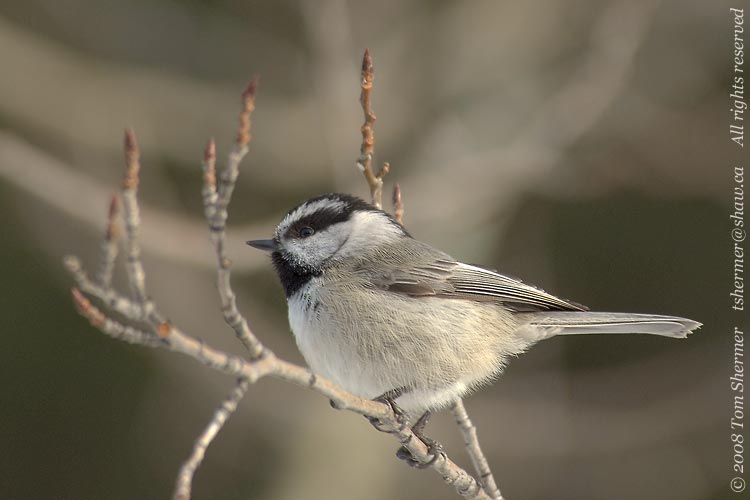 |
Mountain Chickadees have the white stripe above the eye, whereas all other North American Chickadees don't. I've seen Mountain Chickadees before, although they're not common in the Lower Mainland, where Black-capped and Chestnut-backed Chickadees prevail.
I neither expected nor found any Chestnut-backed this day, as I was a bit out of their range. But there were plenty of Black-capped in the flock, like this fellow. |
|
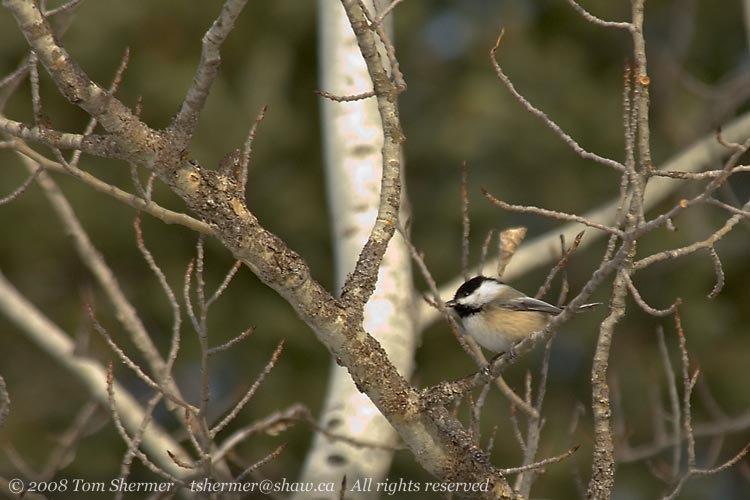 |
Somehow I associate chickadees with happiness, and I'm always a little elevated after seeing a few, especially ones I don't often see, so I was having a good time.
Small birds often flock together, particularly in the winter, so I checked carefully to see if there were any other species hanging around. This paid off, as I found a Red-breasted Nuthatch in the bunch. Nuthatches are small like chickadees, and the Red-breasted has a white stripe above the eye, so it looks a little like a Mountain Chickadee, only with a red breast, a long bill, and a different posture.
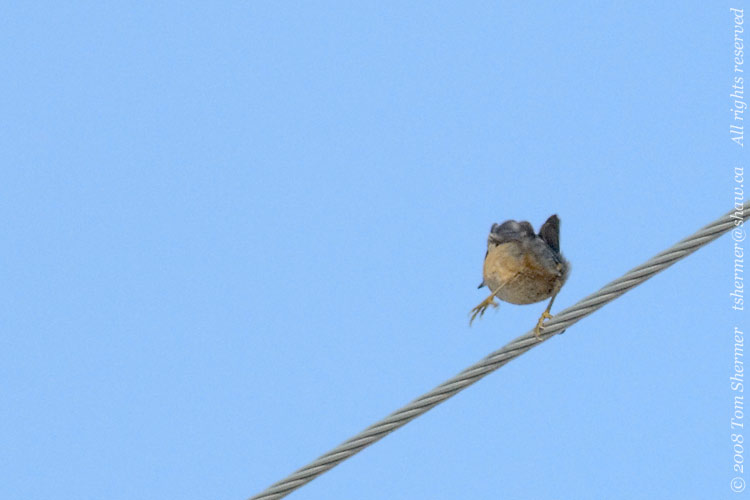
The nuthatch I found was perching in a tree, and I thought him rather ordinary. But soon I learned that behind that everyday red-breasted appearance there was an astounding performer and showman waiting to burst forth.
As I watched, this extraordinary bird went over to the other side of the road and commenced a dangerous and enthralling high-wire act. He carefully tiptoed along the wire. |
|
 |
| When he reached a twisted end of the wire, he acutally jumped over part of the twist. |
|
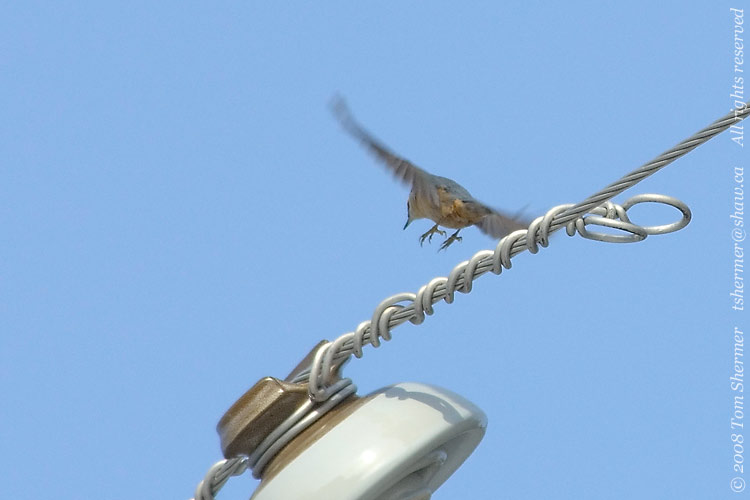 |
That was scary, as he was working without a safety net below and without any kind of support harness that I could see. He must practice a lot to be so sure of himself.
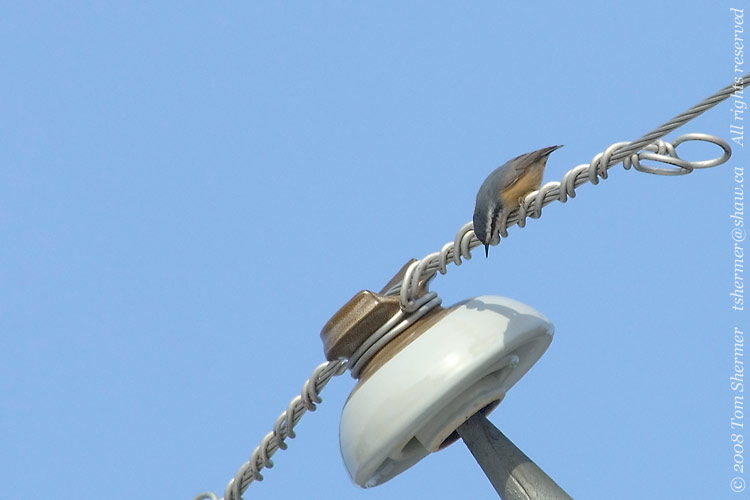
At the end, when he was taking his bows, he bent way over the wire, so that his head was below it. It was pretty amazing. I've never seen a human do that without falling off. |
|
 |
After that, I let my camera hang from its shoulder strap so I could applaud in appreciation, and the Nuthatch hopped over to the platform and then flew away. What a great act!
It always pays to watch the little birds do their thing.
It turns out that some finches had come by to watch the show, and I found them on the other side of the road when the applause died down. My first catch, oddly enough, was another crossbill. |
|
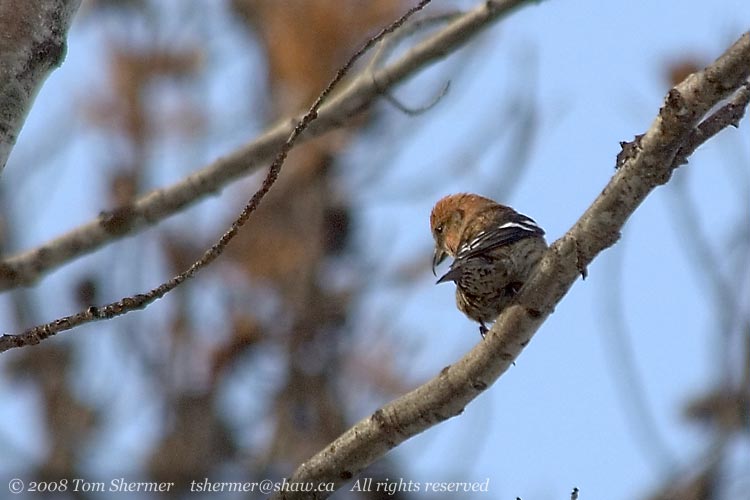 |
The interesting thing about that fellow is the white bars on his wings. It turns out that there are two kinds of crossbills, Red Crossbills and White-winged Crossbills. I had been lucky in guessing that my earlier crossbills were Reds, and I was unlucky in guessing this guy was also Red. I didn't correct that guess until I was reviewing my photos of the day, and actually thought about the wingbars.
So he was my second lifer on the day, but one that I didn't really identify in the field. I should really study my birds more.
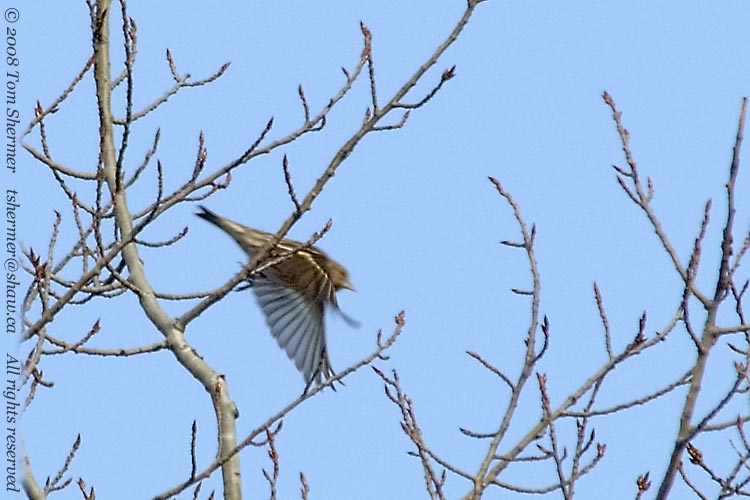
My next subject I didn't need to study...a brown stripey finch with some yellow and a pointy bill is always a Pine Siskin. Even if he's in flight. |
|
 |
| I found a few more finch subjects, mainly crossbills. Here's one of the better of that bunch; it's hard for me to tell, but I think this is a White-winged, based on the amount of dark plumage between his eye and bill. |
|
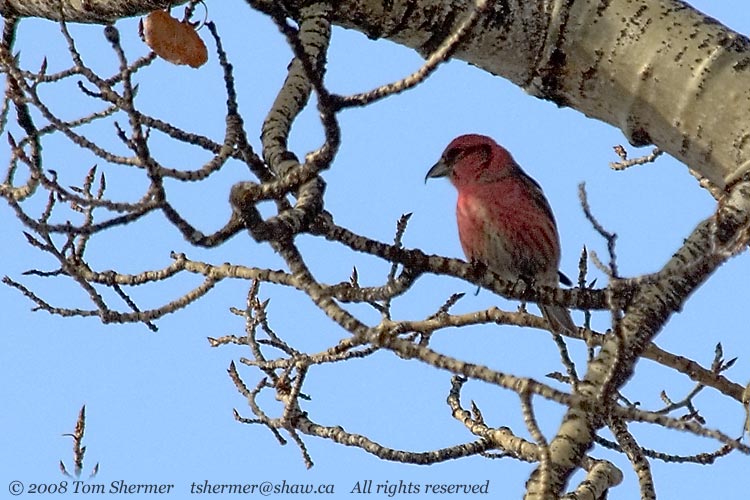 |
Don't hold me to that...he could be a Red. I'm not all that skilled with crossbills.
Over the course of about the last five minutes of finch-shooting, I had been intermittently hearing a woodpecker pecking on some wood. I eventually became curious enough to go looking for him, and thirty meters or so back up the road I found him. He was a male Hairy Woodpecker. |
|
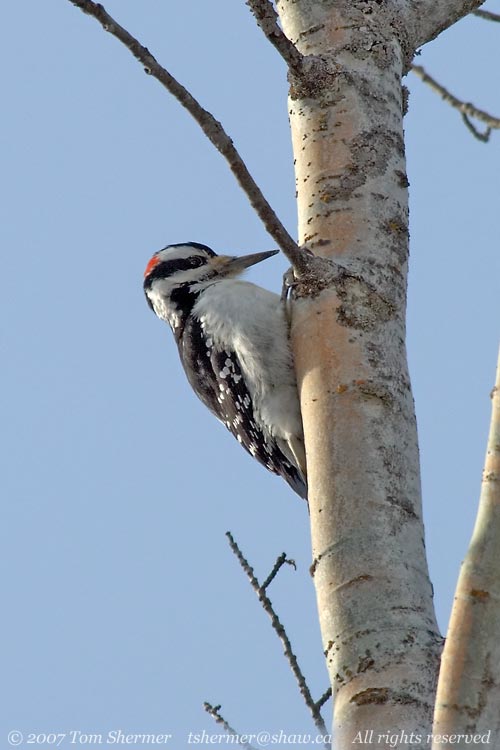 |
Downy Woodpeckers look almost the same, but they're smaller and have a smaller-proportioned bill. I'd seen a few Downies over the past few months, and this fellow was noticably bigger.
It was now getting a bit late in the morning, and I was getting cold, so I drove on back to my motel to warm up, pack up, and check out.
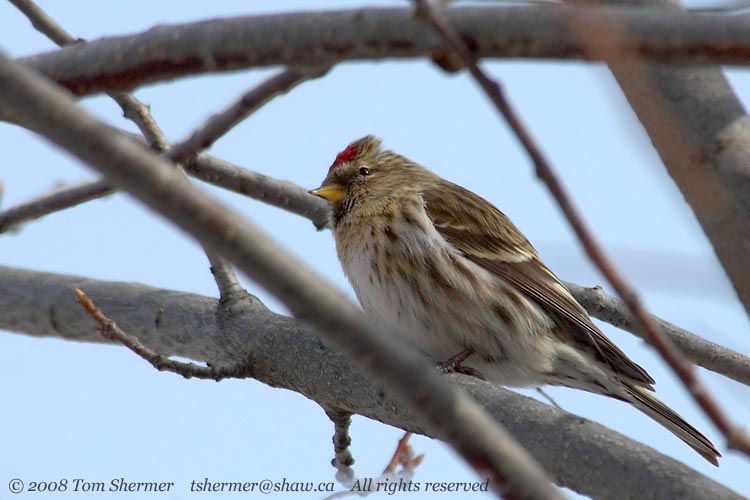
After checkout, I took my camera around the back of the motel and found a few birds in the trees next to an icy path that led to an equally icy little cross-country skiing track. From a distance I saw that they were more brown stripey finches, and I thought that maybe I'd found my missing Carpodacus finches or some more crossbills . But that was not to be the case; these brown stripey finches were different. They were Carduelis flammea, or, as they're commonly called, the Common Redpoll. (They're extremely rarely called the Extremely Rare Redpoll.)
Redpolls are finches with a red spot on their forehead. This one looks to be first-year female. |
|
 |
| The lighting was great but the birds were keeping to the inside of some bushes, so there were always some branches in the way. |
|
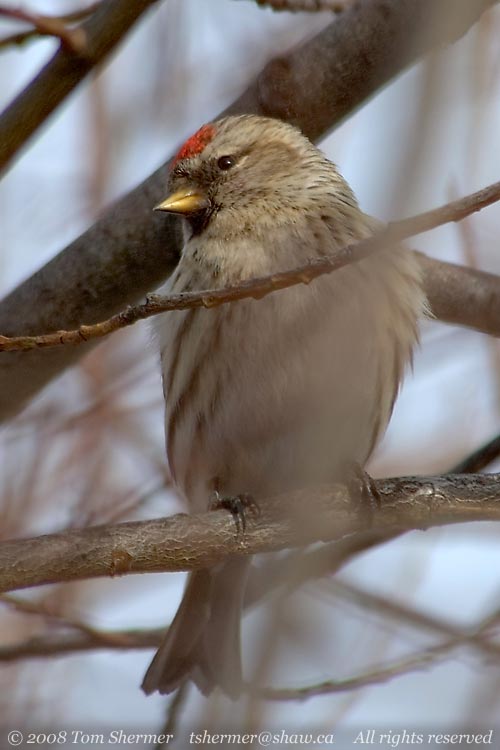 |
| I think that bird above was also a first-year female. The one below, however, is an adult male. The red on his breast gives that away. |
|
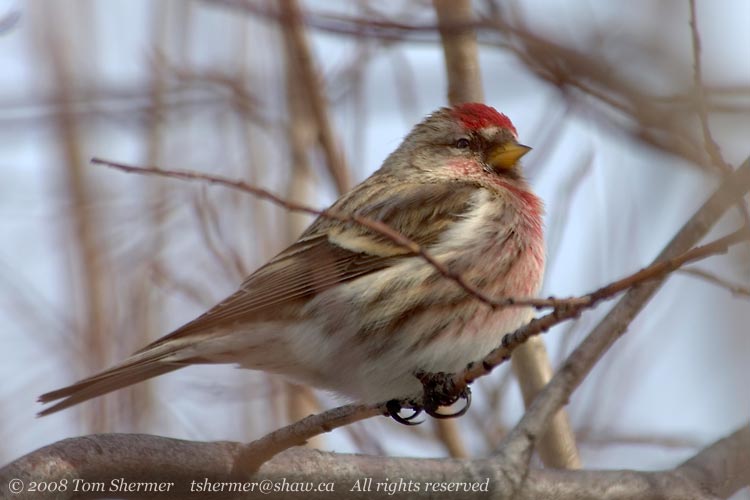 |
I'd only seen one Common Redpoll before in my life, when my friend Ilya had picked one out of some other finches at Reifel. This was way better viewing (and these were way better photos) than I got that day, though, so I was pretty happy. Redpolls are quite a striking bird when you don't have to squint to see them.
My next stop was to pick up some lunch, and then I headed north and turned along another side road, this one called Canim Lake Road. In this area, the air was full of smoke and there was a burning-wood smell. The smoke was coming from some short, circular, burned-out piles of smoldering char in a field to the north of the road.
Naturally I stopped to take some photos, but the smoke didn't turn out too well against the bright sky. Closer to the ground, it was easier to make out. |
|
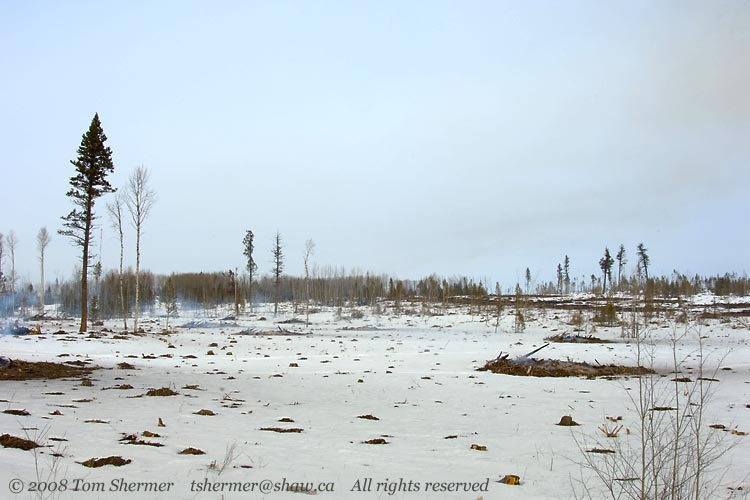 |
| I became enamoured of a small arrangement of trees featuring a Ponderosa Pine and two birches. That arrangement is to the left in the photo above, and it's the subject of the one below. |
|
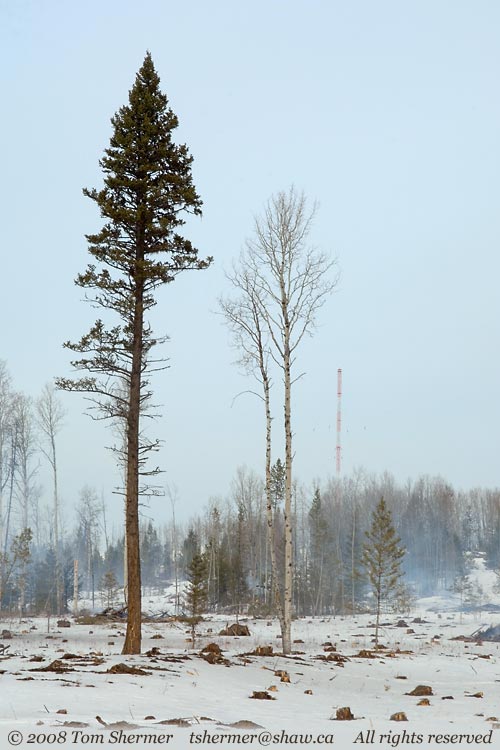 |
Although the smoke does add—dare I say it—some atmosphere to the photo, as well. As does the radio tower.
Anyhow, I took a whole bunch of photos of those three trees, with different placements and different focal lengths. I'll spare you any more of them.
I was wondering what all the smoke and smouldering was about, but there weren't any locals nearby that I could ask, so I got back in the car and drove a bit further down the road. I slammed on the brake when I finally saw and realized what it was that was burning.
Folks, they grow their beavers really big in these parts. |
|
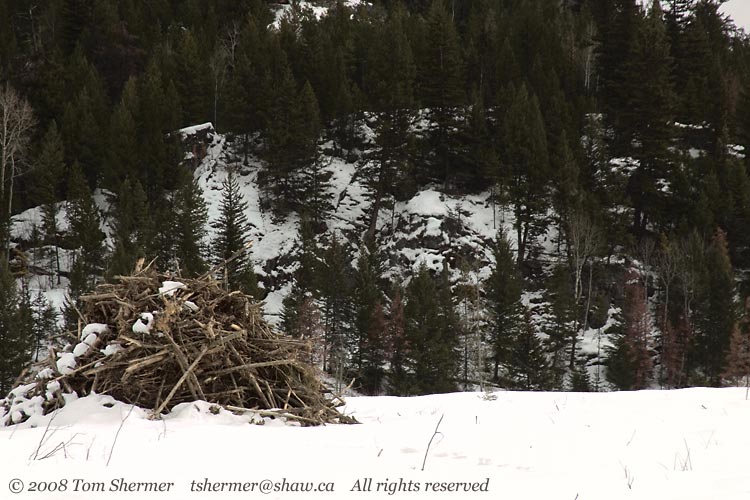 |
Clearly the beavers on the south side of the road were trying to drive the beavers on the north side of the road out of the neighbourhood, and they had burned down their dens to do it.
Never trust a beaver. Especially a beaver who's your neighbour. First it's just a sapling, then a young tree, and then soon all your old-growth is gone. And then when you're not looking, they'll burn down your house. Beavers are bad news.
I continued down the road, eventually coming to Canim Lake itself, which was a rather large affair. I didn't see anything that caught my attention on the way there.
On the way back, though, I was amazed to see a chicken crossing the road. Here is essentially what I saw as I was driving down this (fairly highly-trafficked) road. |
|
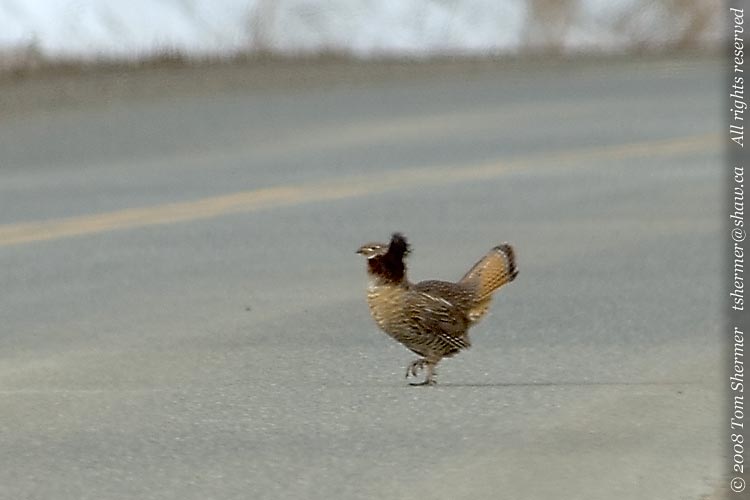 |
I stopped briefly so that I didn't run over the poor bird, but then I continued on because it's a twisty mountainside road and there wasn't a safe place to pull over to the side. I had to drive ahead for a couple of minutes before I even found a place where I could turn around. I arrived back at the chicken-crossing maybe five minutes after I first passed, and the bird was still there. That's when I got the above photo.
And that's not really a chicken...that's a Ruffed Grouse. Birders just call any bird vaguely like that a "chicken".
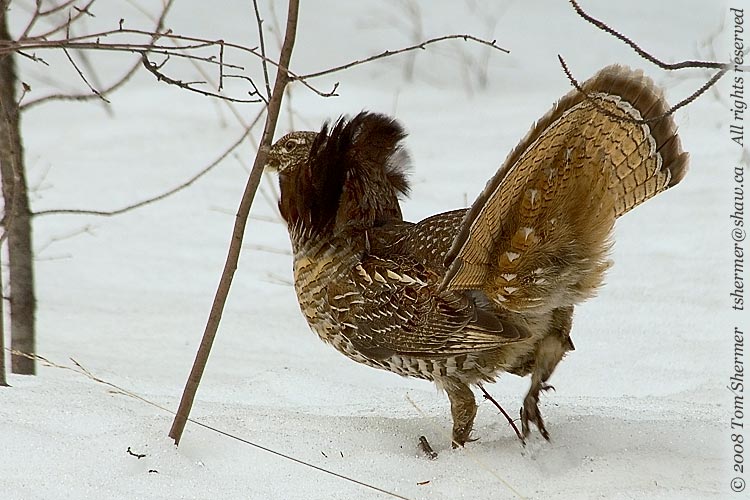
It's a male Ruffed Grouse, which one can tell by the ruff or ruffle of dark feathers around the neck, the ones he's spreading out in a classic spring courtship display. |
|
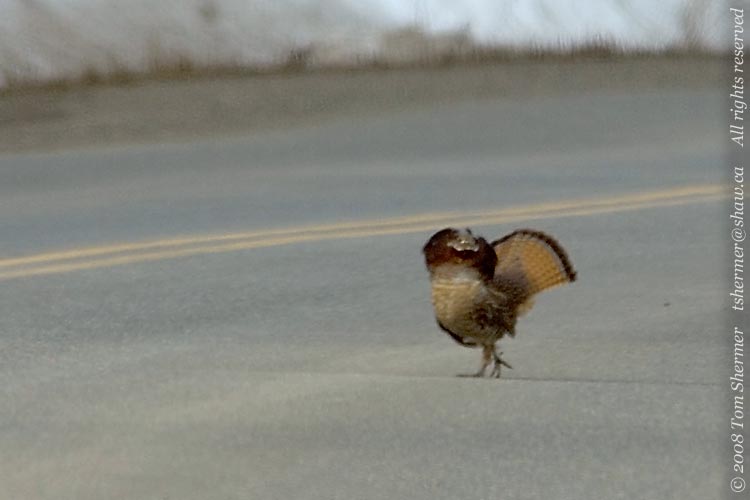 |
That was an impressive display, but the bird may be just a little too nearsighted if he's showing that ruff to me.
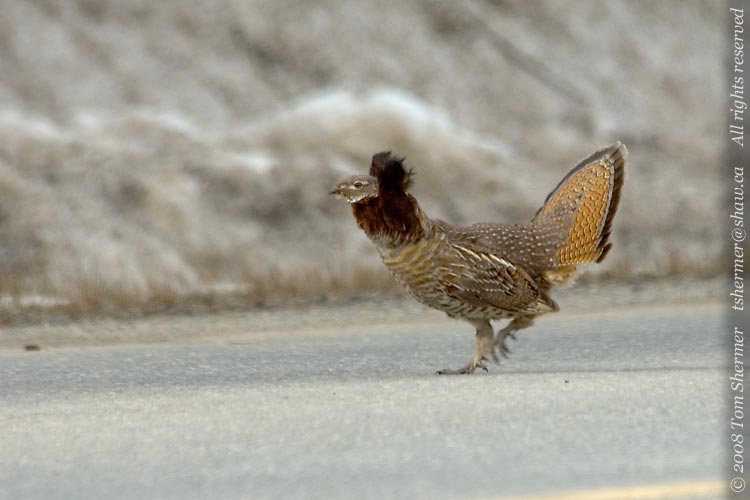
Those two photos above were taken out my car window, and fortuitously on this side of the road there was a widening where I could pull off and park. I did so, and by chasing the bird on foot, I was able to get sharper, more detailed photos. |
|
 |
|
|
|
 |
|
Sadly, he didn't turn to face me again, so I didn't get a sharp photo of him in his full frontal ruff display.
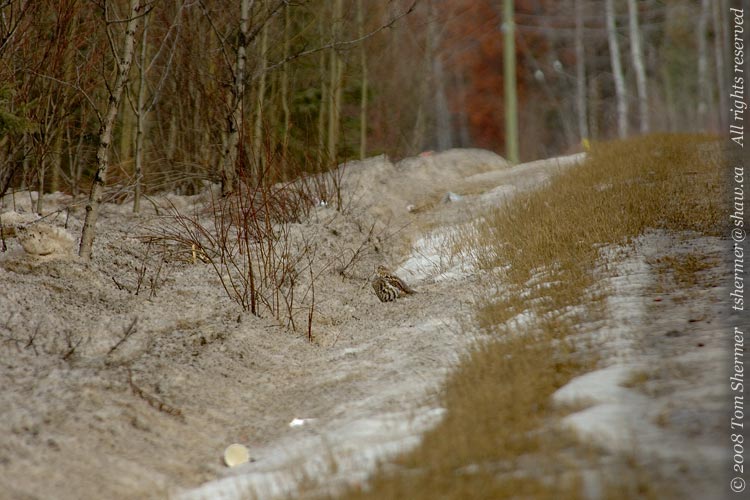
As my Ruffed Chicken strutted off into the woods, I resumed my trip back towards 100-Mile. However, I was now alerted to the presence of chickens, and so I wasn't too surpised to spot one in a roadside ditch a little farther along. |
|
 |
|
Their camouflage is decent and so if you're not looking you might very well miss them.
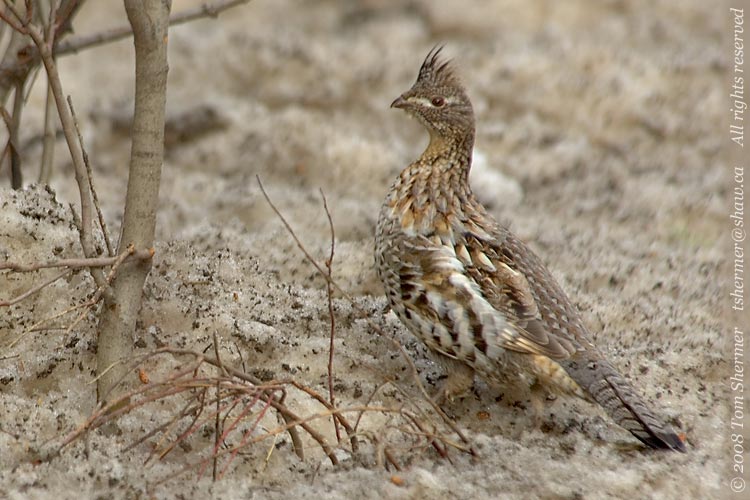
This bird was also a Ruffed Grouse, and as I approached, he started slowly strutting away from me and from the road, as grouse often do. Here's the clearest close shot I got of him. |
|
 |
|
It's hard if not impossible to tell if this one is male or female; if they have their ruff tucked away in their secret ruff-compartment, the males look just like the females.
It was now mid-afternoon and I felt that it'd be a good time to head over to the resort and check in. So I did just that, and after lugging my bags to my room, I picked up my camera and went for a short walk around the parking lot. The only life I found was a pair of Gray Jays. These guys are bold, inquisitive fellows that one often finds around parks and campgrounds. We don't get them in Vancouver. |
|
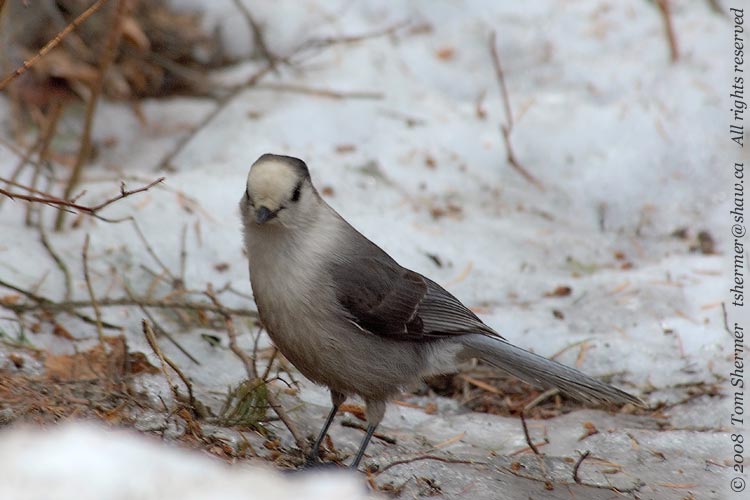 |
Curiously enough, that was the only time I was to see any Gray Jays during my stay at the resort.
Of course, I didn't know that tidbit at this point, but I did know that these birds were the last subjects of my day and maybe for a while. From this point forward, my vacation would be more about health and relaxation than about photography.
I didn't go totally without photography, though, and the photography I did manage to do will be the subject of my next few entries.
Still grousing about the beavers,
Tom
|
|
|