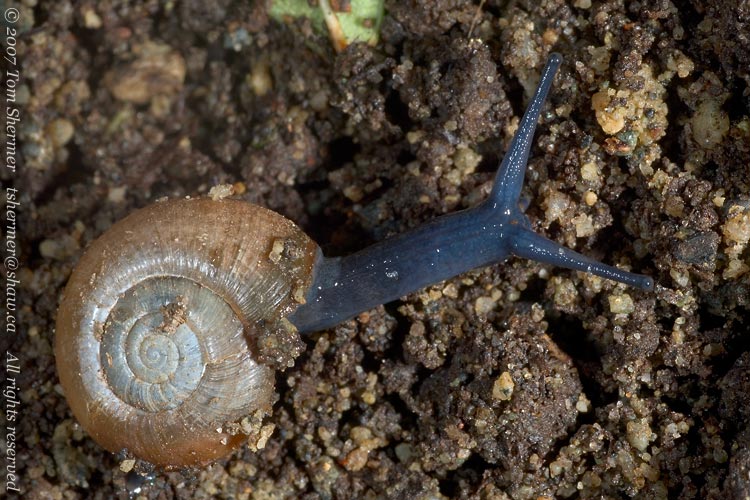
| On the 6th of May, my persistence paid off, and my regular checking of the planting beds around my condo yielded some live snails whose shells I had been seeing for a little while. Much to my surprise, these new fellows were a gorgeous shade of blue. |
|
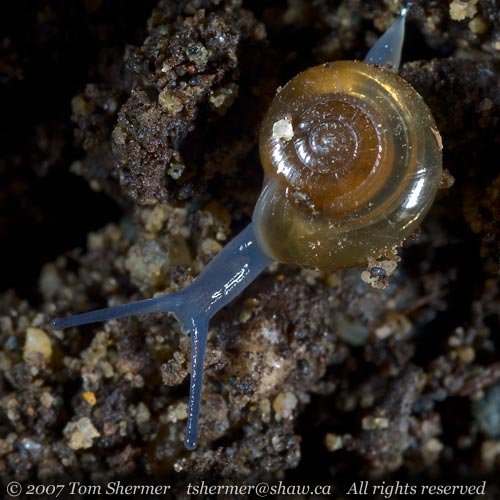 |
This little critter is known as Oxychilus draparnaudi, the Dark-bodied Glass Snail. Glass Snails are named after their relatively transparent shell. |
|
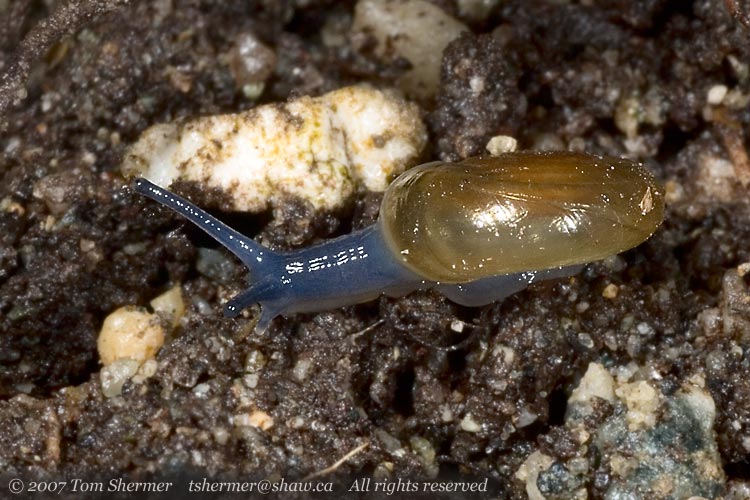 |
| My snail book lists these guys as much bigger (16 mm, or about 3/4 of the diameter of the penny) but these ones looked to be not fully grown. |
|
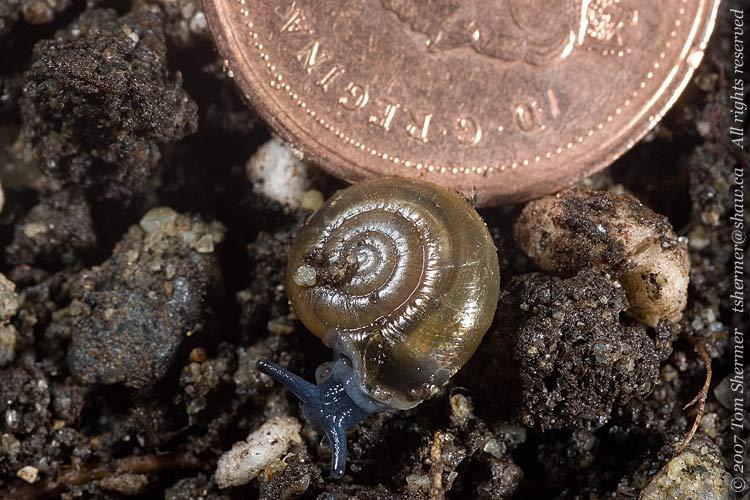 |
One can tell if a snail is full-grown by counting the number of turns (whorls) that the spiral of the shell makes. The above photo show a snail with four whorls, and adults of the species are listed as having 5 or 6 whorls. So a grown-up one of these would probably be about the 16mm that the book claims.
Depending on the camera angle and placement of the lights, both the shell and the animal seem either transparent or opaque. In this very close-in shot, both shell and animal are more opaque than in the photos before. |
|
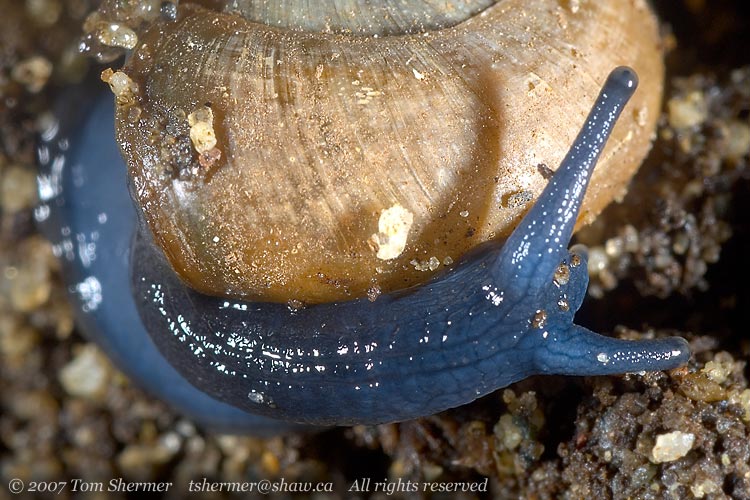 |
| Their shells seem to have a bit of blue coloration in them, as well, and have lots of striae. |
|
 |
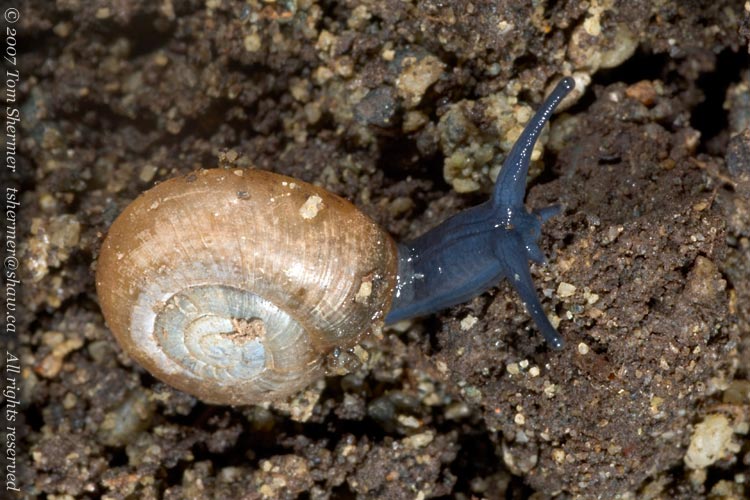
| In the next two shots, my tiny trooper is clambering over a little clod of dirt. |
|
 |
| |
|
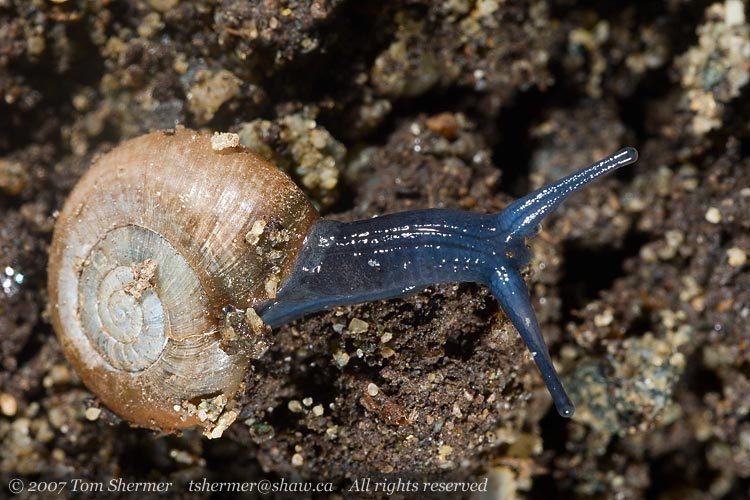 |
Clods of dirt can be serious obstacles when you're small, but if you train hard and keep your underside in good shape, you shouldn't have too much trouble with them. It also helps if you can secrete a good mucus.
|
|
 |
| While I was photographing the snails, A millipede caught my eye, and I took a few photos of it. In this photo, there are also four snails. See if you can find 'em. |
|
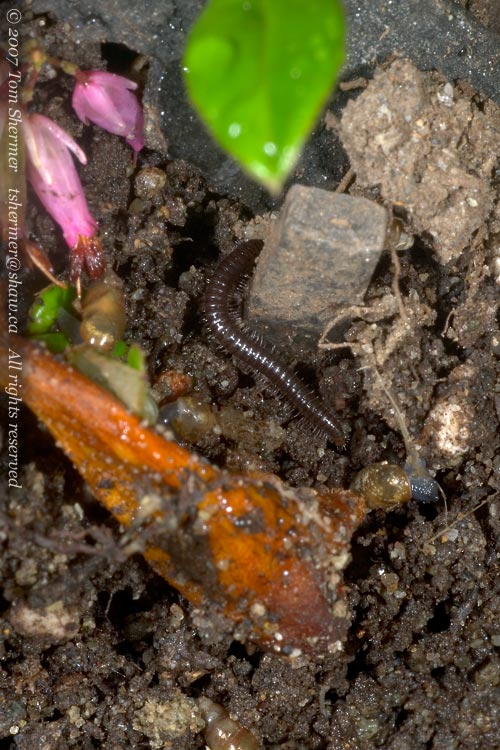 |
Three of the snails are my little blue friends: one right below at the tip of the bottom pink flower, one above the middle part of the orange, and one to the top-right of the orange near the tail of the millipede. There's also a conical shell along the bottom edge of the photo, in the middle. I didn't see that one when shooting, so I didn't check to see if there was anyone home in it.
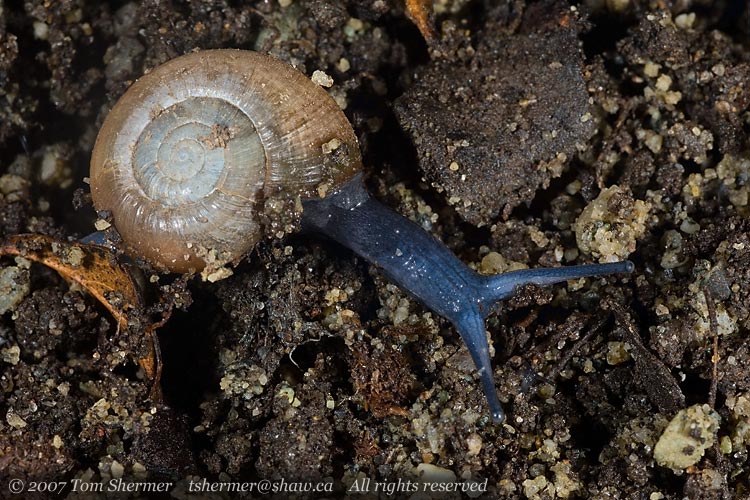
I'll close with one more photo of a Dark-bodied fellow, this one showing more why they're called "dark-bodied." Here it is just the differences in the lighting and the background that cause the animal to appear so much less vivid and so much more of a blue-grey. |
|
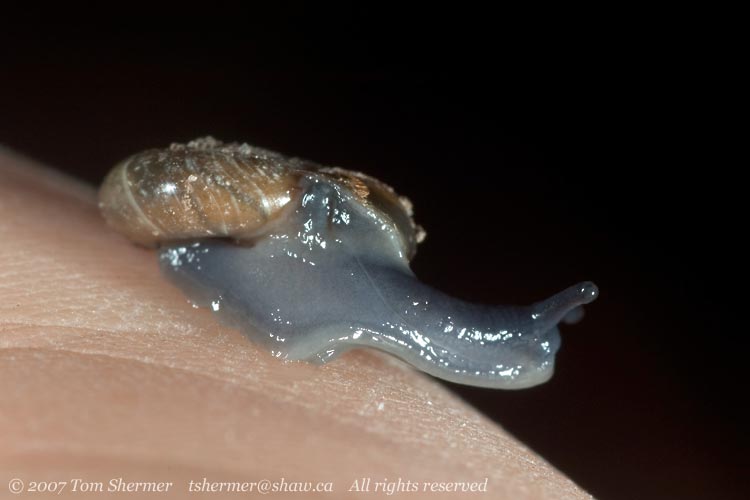 |
You can also see here that his coloration fades to light grey around his foot, which is the textbook description of the coloration of this species.
I didn't take more photos that day, but it was still pretty special, because I don't often find such a colorful and photogenic new species, especially right on my doorstep.
But now I have to find out who lives in the conical shells...
True but not so blue,
Tom
|
|